THE DEAL
Secret roles
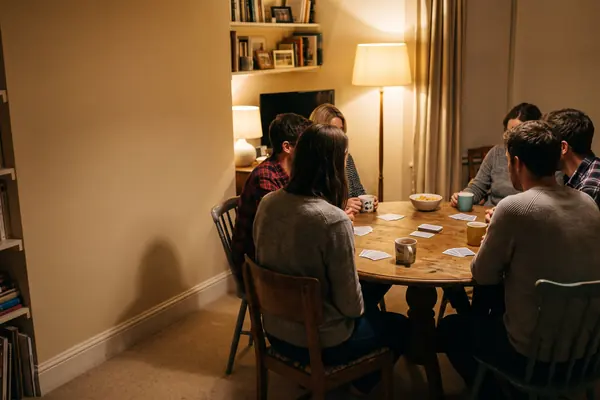
Each player gets a card and keeps it hidden. In the rules on Andrew Plotkin's Werewolf page there are two werewolves, one seer and villagers for everyone else.
Meet the roles doodlemafia
AN INDEPENDENT GAMES GUIDE
A party game played with words.
Meet the roles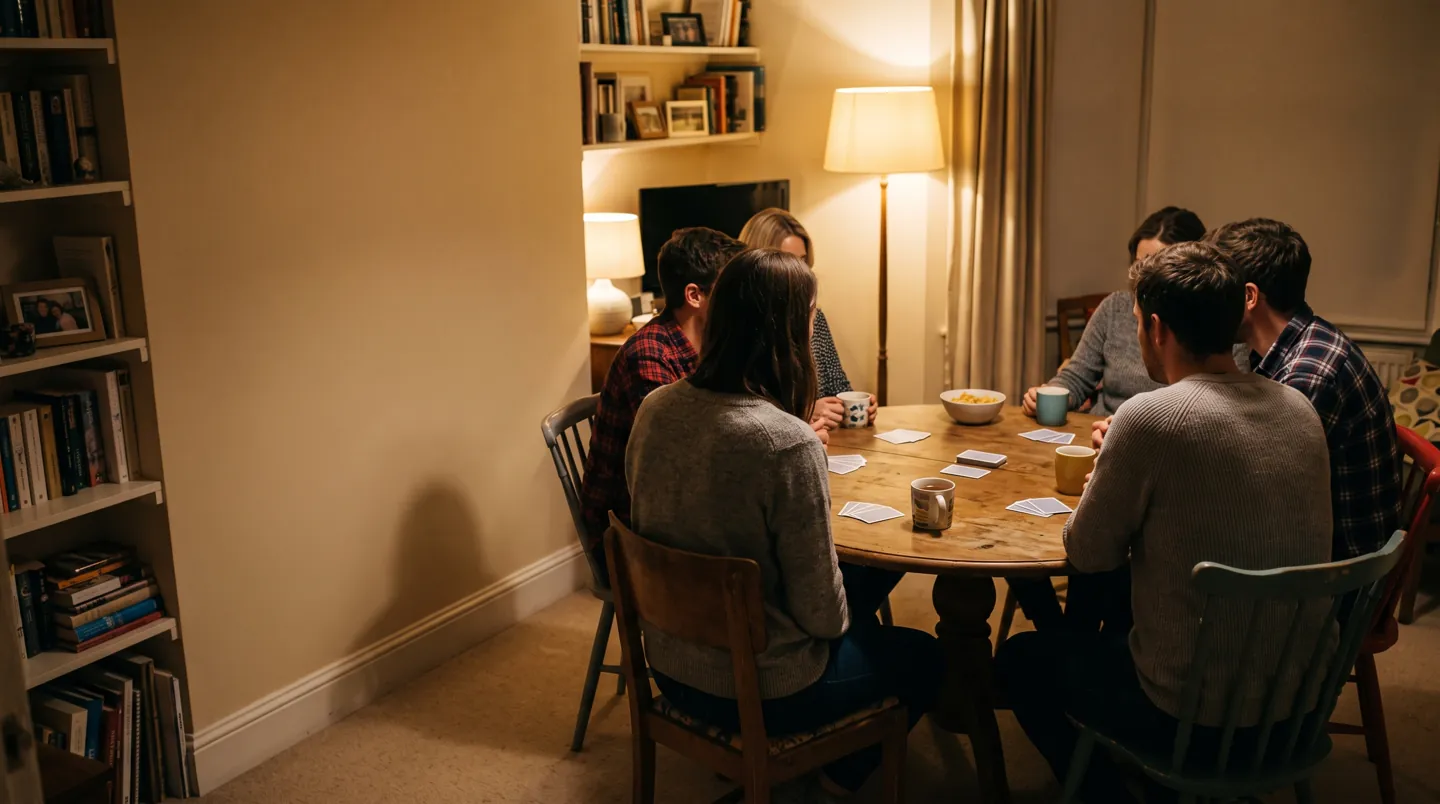
7+ PLAYERSno board, just talk
Mafia, also known as Werewolf, needs a group, a moderator and a few cards. A small team knows who its members are; everyone else has to work that out from what people say, before it is too late.
At a glance
7+ players
Smallest group the rules suggest
The Werewolf rules ask for at least seven players and say nine or eleven is better. An odd number is best, though not essential.
PLAYERS · PLOTKIN'S RULES
≈ √n players
Hidden team size for an even contest, with no detective
In a mathematical model of the game, the two sides had comparable chances when the hidden team was of the order of the square root of the total number of players. Add one detective and it needed to be proportional to the whole group.
THE MATHS · ANNALS OF APPLIED PROBABILITY
TWO NUMBERS WORTH KNOWING
One figure on how many people you need,
one on how big a hidden team has to be.
Braverman, Etesami and Mossel studied the game as a model of groups with partial information: an informed minority that coordinates in secret, and a majority that decides by open discussion and voting.
THE ROLES
Pick a role to see what it knows and what it is trying to do. The bar shows how much hidden information the role starts with.
Based on the Werewolf rules published by Andrew Plotkin and the game model in Braverman, Etesami and Mossel (2008). House rules vary.
THE SHORT ANSWER
There is no board and no dice.
Everything you learn comes from what other players say.
THE DEAL
Each player gets a card and keeps it hidden. In the rules on Andrew Plotkin's Werewolf page there are two werewolves, one seer and villagers for everyone else.
Meet the rolesTHE ROUNDS
At night everyone closes their eyes while the hidden team silently picks a player to remove. By day the whole table talks, accuses and votes someone out.
How a round runsTHE WIN
The village wins by uncovering the whole hidden team. The hidden team wins once its numbers equal the rest of the players.
What the maths says
HOW A ROUND RUNS
These steps follow the Werewolf rules published by Andrew Plotkin. Many groups add roles and house rules of their own.
Shuffle the role cards and hand them out face down. Everyone looks at their own and keeps it secret; only the moderator shows theirs.
Everyone closes their eyes. The hidden team opens theirs, silently agrees on a player to remove, then the seer silently checks one player.
Everyone opens their eyes and hears who is out. The table discusses freely, and a majority vote removes one player, who shows their card.
Players who are out stay silent. The rounds go on until the hidden team is found or matches the rest in number.
WHERE IT CAME FROM
Plotkin's page credits Dimitry Davidoff with inventing the game in 1986, and quotes his account of devising it as a psychology student in Moscow while looking for a class activity. It spread through student dormitories and summer camps under the name Mafia.
Plotkin learned it at a 1997 puzzlers' convention and changed the theme to werewolves. Researchers have since used recorded games to study persuasion and deception in conversation, because so much of the talk is deliberate misdirection.

Questions
Essentially yes. Plotkin's Werewolf page describes the game as also called Mafia, and says he swapped the original Mafia theme for werewolves after learning it in 1997.
Plotkin's rules ask for at least seven, with nine or eleven better, plus one player acting as moderator. An odd number helps avoid tied votes.
In a 2008 mathematical model, the sides had similar chances when the hidden team was around the square root of the group size, if there was no detective. One detective changed the balance sharply.
A 2016 University of Illinois study of 86 online Werewolf transcripts found werewolf players tended to be more talkative and moderately emotional, while other players were usually quieter. It used a small dataset and is a starting point, not a rule.
Researchers have built AI agents for it. A 2023 study trained one on game logs from 15 human players and found it played about as well as average humans as a villager, but worse as a werewolf or seer.
Sources
ABOUT THIS NAME
doodlemafia.com is part of the DoodleSale portfolio. It isn't in an auction right now, but you can ask about leasing it.